Epic Bible
The story of Noah's Ark, told in Genesis 6–9, is the account of how God judged a world filled with violence by sending a great flood, and how He saved Noah, his family and the animals in a huge wooden boat. God told Noah to build an ark 300 cubits long, about 450 feet. Noah's family of eight lived in it for just over a year. When they came out, God made a covenant never again to destroy the earth by a flood and set the rainbow in the clouds as its sign.
The World Before the Flood
Noah was the tenth generation from Adam, and by his time the world had changed dramatically. Cain's descendants built cities, worked bronze and iron, and made music (Genesis 4:17–22). Civilization was rising. So was violence.
Genesis 6 opens with the mysterious passage about the "sons of God," the daughters of men and the mighty men of old. You can read about that debate on our page Who Were the Nephilim? Whatever the details, the result was clear. Humanity had turned away from God completely.
And God saw that the wickedness of man was great in the earth, and that every imagination of the thoughts of his heart was only evil continually.
— Genesis 6:5 (KJV)
The very next verse shows us God's heart. His first response was not cold anger but sorrow.
And it repented the LORD that he had made man on the earth, and it grieved him at his heart.
— Genesis 6:6 (KJV)
Why Did God Flood the Earth?
Genesis gives three clear reasons:
- Wickedness had reached the heart. Not just some actions, but "every imagination" of the heart was "only evil continually" (Genesis 6:5).
- The earth was corrupt. "All flesh had corrupted his way upon the earth" (Genesis 6:12).
- The earth was filled with violence. God told Noah plainly that this was the reason for the judgment (Genesis 6:13).
The flood was not sudden or careless. Peter writes that "the longsuffering of God waited in the days of Noah, while the ark was a preparing" (1 Peter 3:20), and he calls Noah "a preacher of righteousness" (2 Peter 2:5). The years of building were also years of warning and mercy.
Noah Found Grace
In the middle of that dark world, one sentence changes everything.
But Noah found grace in the eyes of the LORD.
— Genesis 6:8 (KJV)
Genesis adds that Noah was "a just man and perfect in his generations, and Noah walked with God" (Genesis 6:9). The same words had been used of his great-grandfather Enoch, the man God took. You can read about him in Who Was Enoch in the Bible?
Noah was the son of Lamech and the grandson of Methuselah. His name sounds like the Hebrew word for rest or comfort (Genesis 5:28–29). He had three sons: Shem, Ham and Japheth.
How Big Was Noah's Ark?
God gave Noah precise instructions.
Make thee an ark of gopher wood; rooms shalt thou make in the ark, and shalt pitch it within and without with pitch.
— Genesis 6:14 (KJV)
And this is the fashion which thou shalt make it of: The length of the ark shall be three hundred cubits, the breadth of it fifty cubits, and the height of it thirty cubits.
— Genesis 6:15 (KJV)
A cubit was the length from the elbow to the tip of the middle finger, usually estimated at about 18 inches. Using that common measure, the ark's size was:
| Measure | Cubits | Feet (approx.) | Meters (approx.) |
|---|---|---|---|
| Length | 300 | 450 | 137 |
| Width | 50 | 75 | 23 |
| Height | 30 | 45 | 14 |
If a longer "royal" cubit of about 20.6 inches is used, the ark becomes roughly 515 feet long. Either way, it was enormous, longer than an American football field including both end zones.
God also told Noah to make three decks, a door in the side and a window or opening finished a cubit from the top (Genesis 6:16). Nobody knows exactly what "gopher wood" was. It may have been cypress or another resinous tree, but the word appears only here in the Bible.
The ark was not designed to sail anywhere. It was a floating box made to keep its passengers safe, and its proportions, six times as long as it is wide, resemble those of stable cargo ships today.
Two by Two: The Animals Enter the Ark
Many people remember that the animals went in "two by two," and that is true for most of them (Genesis 6:19–20). But Genesis 7:2–3 adds that Noah was to take clean animals and birds "by sevens," which many readers understand as seven pairs. The extra clean animals would later be used for sacrifice.
God brought the animals to Noah. Noah also gathered food for his family and for every creature on board (Genesis 6:21). Eight people entered the ark: Noah, his wife, his three sons and their three wives (1 Peter 3:20).
Then came one of the most moving lines in the story.
And they that went in, went in male and female of all flesh, as God had commanded him: and the LORD shut him in.
— Genesis 7:16 (KJV)
Noah did not close the door. God did.
The Flood Timeline
Genesis gives careful dates, all counted from Noah's age. Here is the timeline of the flood in order:
- Seven days of waiting. After Noah and the animals entered, there were seven days before the rain began (Genesis 7:4, 10).
- The flood begins. Noah was 600 years old.
In the six hundredth year of Noah's life, in the second month, the seventeenth day of the month, the same day were all the fountains of the great deep broken up, and the windows of heaven were opened. And the rain was upon the earth forty days and forty nights.
— Genesis 7:11–12 (KJV)
- Forty days of rain. The waters rose and lifted the ark above the earth (Genesis 7:17).
- 150 days of high water. The waters covered the mountains by fifteen cubits and "prevailed upon the earth an hundred and fifty days" (Genesis 7:20, 24).
- The ark rests. On the seventeenth day of the seventh month, exactly five months after the flood began, the ark came to rest "upon the mountains of Ararat" (Genesis 8:4).
- Mountaintops appear. On the first day of the tenth month (Genesis 8:5).
- The raven and the dove. Forty days later Noah opened the window and sent out a raven, then a dove, which found no place to rest and came back (Genesis 8:6–9).
- The olive leaf. Seven days later he sent the dove again.
And the dove came in to him in the evening; and, lo, in her mouth was an olive leaf pluckt off: so Noah knew that the waters were abated from off the earth.
— Genesis 8:11 (KJV)
- The dove does not return. After seven more days, the dove flew away for good (Genesis 8:12).
- The ground is dry. On the first day of the first month of Noah's 601st year, Noah removed the covering and saw dry ground (Genesis 8:13).
- Leaving the ark. On the twenty-seventh day of the second month, the earth was dried, and God told Noah to go out (Genesis 8:14–16).
From the start of the flood to the day they left the ark was one year and ten days. Noah's family spent more than a year inside.
The Covenant and the Rainbow
The first thing Noah did on dry ground was build an altar and offer sacrifices to the Lord (Genesis 8:20). God then promised that while the earth remains, "seedtime and harvest, and cold and heat, and summer and winter, and day and night shall not cease" (Genesis 8:22).
God blessed Noah's family, told them to be fruitful and fill the earth, and stressed that every human life is precious because people are made in God's image (Genesis 9:1, 6). Then He made a covenant, not only with Noah but with every living creature.
I do set my bow in the cloud, and it shall be for a token of a covenant between me and the earth.
— Genesis 9:13 (KJV)
God said that when the bow appears, He Himself will remember His covenant, and "the waters shall no more become a flood to destroy all flesh" (Genesis 9:15). The rainbow is a sign of mercy written across the sky, and it still appears after the storm.
What Happened After the Flood
Noah lived 350 years after the flood and died at the age of 950 (Genesis 9:28–29). Genesis also records a sad episode in which Noah planted a vineyard and became drunk, a reminder that even the man who found grace was still a sinner who needed it (Genesis 9:20–27). From his three sons came the nations listed in Genesis 10.
What the Story of Noah Means for Us
The New Testament presents Noah as a model of faith that acts before it sees.
By faith Noah, being warned of God of things not seen as yet, moved with fear, prepared an ark to the saving of his house; by the which he condemned the world, and became heir of the righteousness which is by faith.
— Hebrews 11:7 (KJV)
Jesus also pointed to the days of Noah. People were "eating and drinking, marrying and giving in marriage" until the flood came (Matthew 24:38). The warning is not meant to frighten but to wake us up: ordinary life can make us forget God, and His patience is an invitation. As Peter wrote, the Lord is "not willing that any should perish, but that all should come to repentance" (2 Peter 3:9).
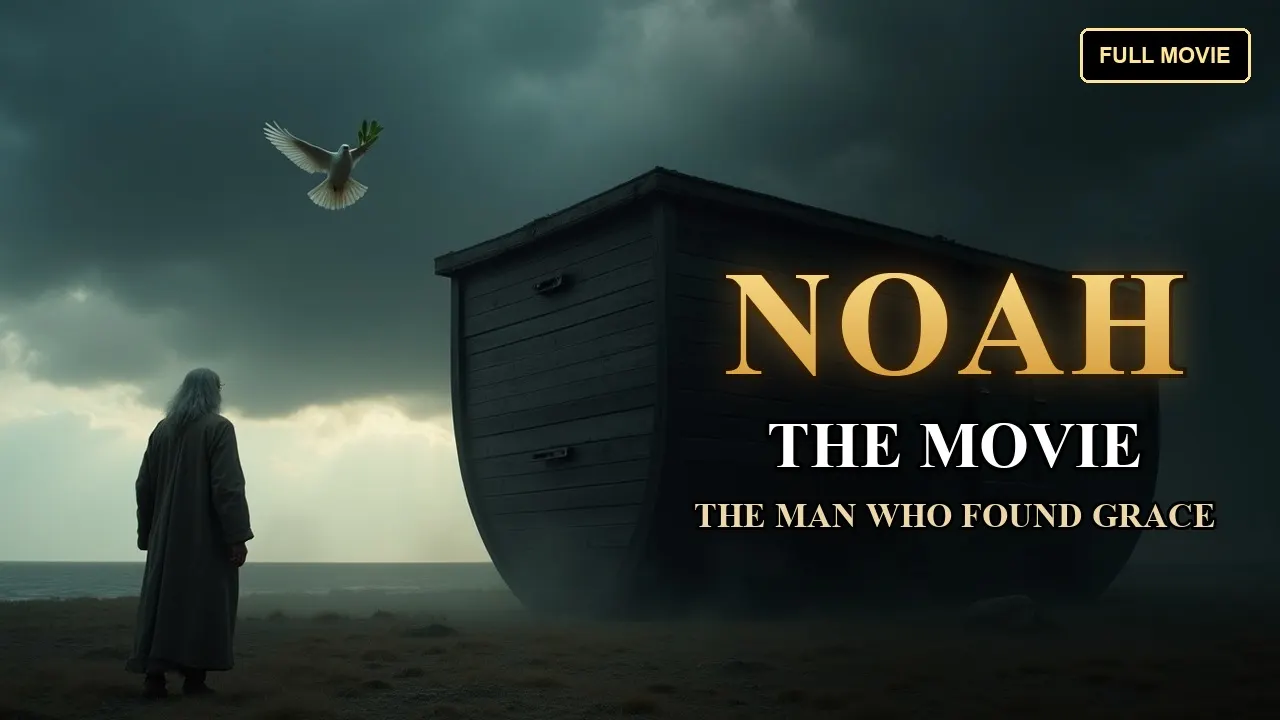
An Epic Bible Movies film about Noah is coming soon on our YouTube channel. Until then, you can watch the story of the man who walked with God just before him in Enoch – The Movie.

Frequently Asked Questions
How long was Noah on the ark?
Noah and his family were in the ark for about one year and ten days. They entered seven days before the rain began, in Noah's 600th year, and came out on the twenty-seventh day of the second month of his 601st year (Genesis 7:10–11; 8:14–16).
How old was Noah when he built the ark?
Genesis does not say when construction began. Noah was 500 years old when he began to have his three sons (Genesis 5:32) and 600 when the flood came (Genesis 7:6). Many readers connect the 120 years in Genesis 6:3 with the time of building, but the Bible does not state this directly.
Where did Noah's Ark land?
Genesis 8:4 says the ark rested "upon the mountains of Ararat." Ararat was an ancient region, roughly in today's eastern Turkey and Armenia, so the verse points to a mountain range rather than one specific peak. Many expeditions have searched for the ark, but no discovery has been confirmed.
Was the flood worldwide or local?
Christians hold different views. Many read Genesis as describing a global flood that covered the whole earth. Others believe it covered the whole world known to Noah, a vast regional flood. Both groups agree that the flood was a real judgment and that God saved Noah by grace.
What does the rainbow mean in the Bible?
The rainbow is the sign of God's covenant with Noah and every living creature that He will never again destroy all life with a flood (Genesis 9:13–15). It is a reminder of God's faithfulness and mercy after judgment.
Watch the Bible come alive
New full-length Bible movies every week on our YouTube channel.
▶ Subscribe to Epic Bible Movies