Epic Bible
The Book of Enoch is not in most Bibles because it was written centuries after the real Enoch lived, it was never part of the Hebrew Scriptures, and most of the early church did not receive it as inspired. It was not hidden or banned. It was read, discussed and even quoted, but Jews and most Christians concluded that it did not carry the authority of Scripture. One ancient church, the Ethiopian Orthodox Tewahedo Church, does include it in its Bible to this day.
That short answer leaves a lot of good questions open. What exactly is this book? Why does the New Testament quote it? And why do some Christians read it while others set it aside? Here is a calm, honest look at each one.
Who Was Enoch in the Bible?
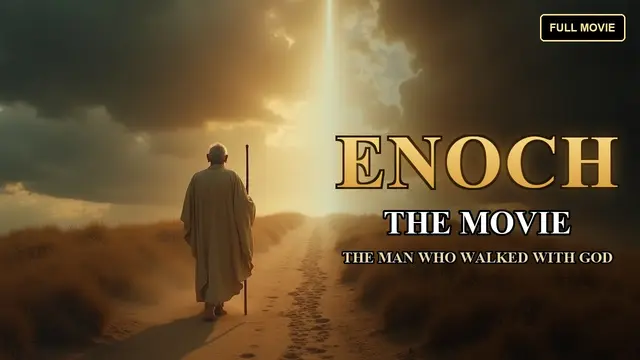
Enoch appears only briefly in Genesis. He was the seventh generation from Adam, the father of Methuselah, and a man whose life ended in a way no one else's did (Genesis 5:21–23).
And Enoch walked with God: and he was not; for God took him.
— Genesis 5:24 (KJV)
The letter to the Hebrews adds that Enoch did not see death and that he "pleased God" (Hebrews 11:5). Because the Bible says so little about such a remarkable man, later writers were eager to fill the silence. You can read his full biblical story, and watch the film about his life, on our page Who Was Enoch in the Bible?.
What Is the Book of Enoch?
When people say "the Book of Enoch," they usually mean the work scholars call 1 Enoch. It is not a single book written at one time. It is a collection of five sections that were joined together over a long period:
- The Book of the Watchers (chapters 1–36): the story of angels called Watchers who came down to earth, took human wives and fathered giants. It expands the few verses in Genesis 6:1–4.
- The Book of Parables, also called the Similitudes (chapters 37–71): visions of judgment and of a heavenly figure called the Son of Man and the Elect One.
- The Astronomical Book (chapters 72–82): a detailed calendar of the sun, moon and stars, based on a 364-day year.
- The Book of Dream Visions (chapters 83–90): a history of Israel told through animal symbols.
- The Epistle of Enoch (chapters 91–108): warnings to the wicked and encouragement to the righteous.
There are also two later and quite different works, known as 2 Enoch and 3 Enoch. They are separate books and should not be confused with 1 Enoch.
When Was the Book of Enoch Written?
Most scholars date the oldest parts of 1 Enoch to roughly the third century before Christ, with other sections added over the next two or three centuries. The Book of Parables is usually placed latest, around the time of Jesus or shortly before.
Aramaic fragments of several sections were found among the Dead Sea Scrolls at Qumran. That discovery showed that the book was read and copied by some Jewish groups before the time of Christ. Interestingly, no fragment of the Book of Parables was found there.
This dating is the heart of the matter. The biblical Enoch lived long before the flood, yet the book bearing his name was composed thousands of years later. Writing under the name of an ancient hero was a common practice in that era, and readers did not always mean it as deception. Still, it means the book cannot be the actual words of the man who walked with God.
Why Does Jude Quote the Book of Enoch?
This is the question that makes many readers pause. The short letter of Jude, near the end of the New Testament, contains a prophecy credited to Enoch. It matches 1 Enoch 1:9 very closely.
And Enoch also, the seventh from Adam, prophesied of these, saying, Behold, the Lord cometh with ten thousands of his saints,
— Jude 1:14 (KJV)
To execute judgment upon all, and to convince all that are ungodly among them of all their ungodly deeds which they have ungodly committed, and of all their hard speeches which ungodly sinners have spoken against him.
— Jude 1:15 (KJV)
Jude also speaks of angels who left their proper home (Jude 1:6), an idea told at length in the Book of the Watchers. So Jude clearly knew this book and expected his readers to know it.
Christians have understood this in a few ways:
- Jude quoted a true saying, not a whole book. Many believe the Holy Spirit led Jude to affirm that this particular prophecy was true, without approving everything else in 1 Enoch.
- Quoting is not the same as canonizing. The apostle Paul quoted pagan Greek poets in his sermons and letters, and no one concludes that those poets belong in the Bible.
For in him we live, and move, and have our being; as certain also of your own poets have said, For we are also his offspring.
— Acts 17:28 (KJV)
- Some early Christians took the quote as a reason to honor the whole book. The North African writer Tertullian, around AD 200, argued that 1 Enoch should be accepted, partly because Jude cites it.
So Jude's quotation is real and important. But on its own it was not enough to persuade most of the church that 1 Enoch was Scripture.
Why Jews Did Not Include It
The Bible of Jesus and the apostles was the Hebrew Scriptures, which Christians call the Old Testament. Paul says that the Jewish people were entrusted with these writings.
Much every way: chiefly, because that unto them were committed the oracles of God.
— Romans 3:2 (KJV)
1 Enoch was never part of that collection. The first-century Jewish historian Josephus wrote that the reliable line of prophets ended in the days of the Persian king Artaxerxes, which placed later writings in a lower category. Since 1 Enoch came well after that time, mainstream Judaism did not treat it as holy Scripture. Some of its ideas, such as its special calendar, also differed from the practice of most Jews.
Why Most Christian Churches Did Not Include It
The early church inherited the Jewish Scriptures and then recognized the writings of the apostles. Over the first few centuries, church leaders asked a few simple questions about any book: Is it connected to a prophet or apostle? Is it received widely by the churches? Does it agree with the rest of Scripture?
1 Enoch had trouble with all three. It was clearly not written by Enoch himself. It was used in some regions but never widely received. And some of its details, especially its long accounts of angels and its astronomy, did not sit easily with the rest of the Bible. Augustine, writing in the early fifth century, said the book was not accepted because its origin was too uncertain, even though he granted that the real Enoch did say some inspired things. Jerome also treated it as outside the canon.
As a result, the Bible used by Roman Catholics, Eastern Orthodox churches (apart from the Ethiopian church) and Protestants does not contain 1 Enoch. Notably, it is not part of the Catholic "Deuterocanonical" books or the Protestant Apocrypha either. It sits outside all of them.
The Ethiopian Orthodox Church and 1 Enoch
The one major Christian tradition that kept 1 Enoch is the Ethiopian Orthodox Tewahedo Church, one of the oldest churches in the world. Its Bible, written in the ancient language Ge'ez, includes 1 Enoch as Scripture, along with the Book of Jubilees.
This is why the book survived at all. For many centuries, the complete text existed only in Ethiopia. In the 1770s, the Scottish traveler James Bruce brought Ge'ez copies back to Europe, and an English translation by Richard Laurence appeared in 1821. Most English editions today still depend on the Ethiopian manuscripts.
It is worth saying plainly that Ethiopian Christians are not reading a "secret" or "forbidden" book. They are faithful believers following their church's long tradition, and their careful copying preserved an ancient text for the whole world.
Is the Book of Enoch Banned or Hidden?
No. This is one of the most common myths online. No church council issued a famous ban on 1 Enoch, and nobody is hiding it. It simply fell out of use in most places because it was not accepted as Scripture, and copies stopped being made. Today it is easy to find in English, often in collections with other ancient Jewish writings.
Should Christians Read the Book of Enoch?
Here Christians honestly differ. Many scholars and pastors find it useful as a window into Jewish thought between the Old and New Testaments. It helps explain phrases in Jude and 2 Peter, and it shows what some people in Jesus' day believed about angels, judgment and the coming Messiah.
Others urge caution, because its vivid stories about angels and giants can easily lead readers into speculation that goes far beyond what the Bible actually teaches. A sensible approach, held by many believers, is to read it as history, not as Scripture, and to test everything by the Bible itself.
What matters most about Enoch is already in Genesis. He walked with God in a dark generation, and God took him. That simple faith is still open to anyone, and you can see his story come to life in Enoch – The Movie.
Frequently Asked Questions
Is the Book of Enoch in any Bible?
Yes. The Ethiopian Orthodox Tewahedo Church includes 1 Enoch in its Old Testament, and the Eritrean Orthodox Church follows the same tradition. Ethiopian Jews, known as Beta Israel, also honor it. Catholic, Eastern Orthodox and Protestant Bibles do not include it.
Did Jesus quote the Book of Enoch?
The Gospels never record Jesus quoting 1 Enoch directly. Jesus often called Himself the "Son of Man," a title that also appears in the Book of Parables, but it comes first from Daniel 7:13. Most scholars see shared language and ideas rather than a quotation.
Who wrote the Book of Enoch?
We do not know the names of its authors. 1 Enoch was written by several Jewish writers over a few centuries before and around the time of Christ, and they presented it in the name of Enoch. The biblical Enoch lived long before the flood, so he did not write it.
What does the Book of Enoch say about the Nephilim?
The Book of the Watchers says that 200 angels came down on Mount Hermon, married human women and fathered giants, who filled the earth with violence. It is the most detailed ancient version of the "angels" view of Genesis 6. You can compare it with what the Bible itself says on our page Who Were the Nephilim?.
Was the Book of Enoch removed from the Bible?
No. It was never part of the Hebrew Scriptures, so it was not removed from them. Some early Christians valued it, but it was never accepted across the church, and it gradually fell out of use outside Ethiopia.
Is it a sin to read the Book of Enoch?
The Bible does not forbid reading ancient books, and many Christians read 1 Enoch for history and background. The important thing is to treat it as a human writing, not as the Word of God, and to measure its claims by Scripture.
Watch the Bible come alive
New full-length Bible movies every week on our YouTube channel.
▶ Subscribe to Epic Bible Movies